Nsambya, Kampala – August 2025 John Paul II Justice and Peace Centre (JPIIJPC), in collaboration with the Julius Nyerere Leadership Centre at Makerere University, has officially launched a research report on the status of human trafficking in Uganda. The launch event, held at JPIIJPC’s premises in Nsambya, drew key stakeholders from government, civil society, diplomatic …

Nsambya, Kampala – August 2025
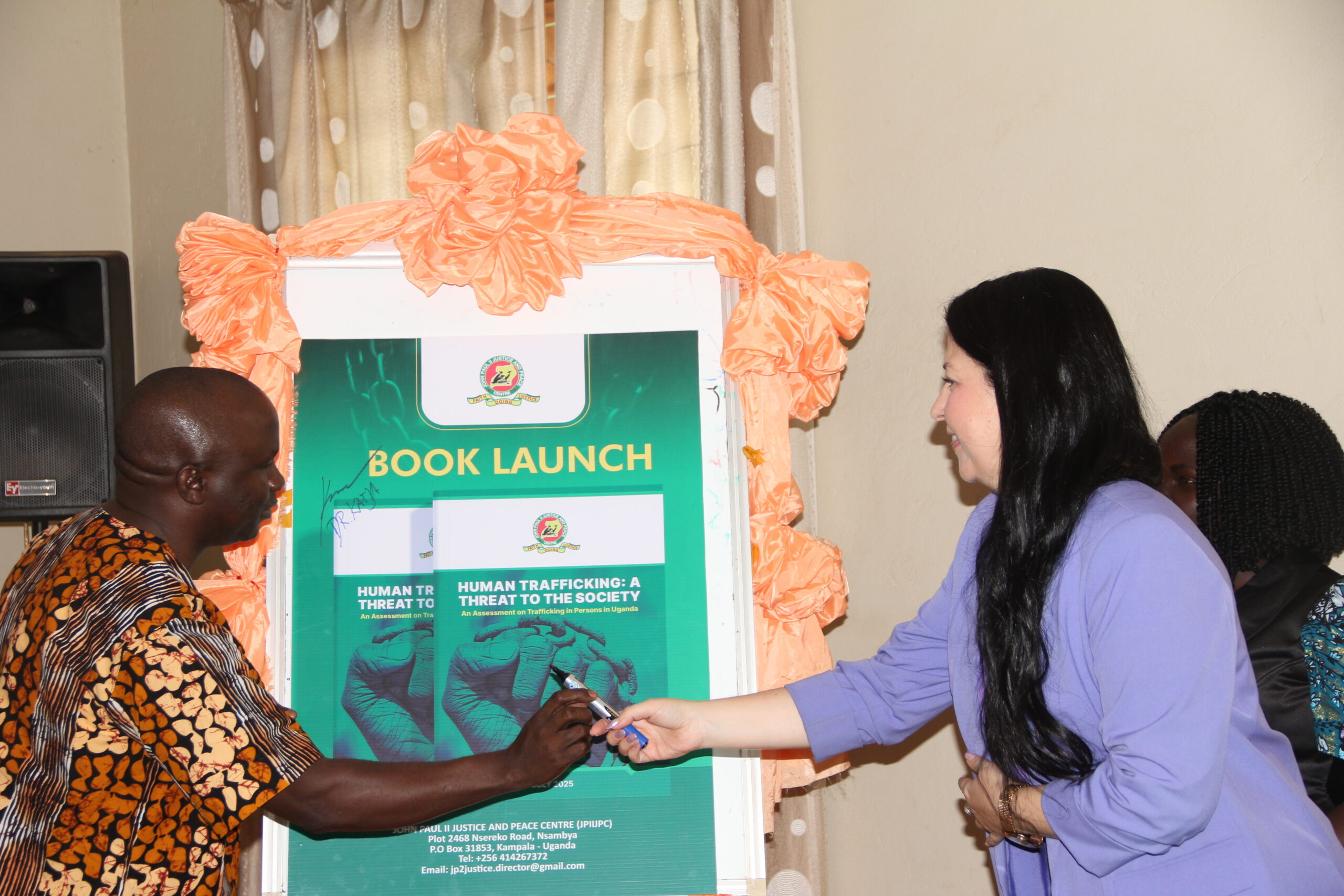
John Paul II Justice and Peace Centre (JPIIJPC), in collaboration with the Julius Nyerere Leadership Centre at Makerere University, has officially launched a research report on the status of human trafficking in Uganda. The launch event, held at JPIIJPC’s premises in Nsambya, drew key stakeholders from government, civil society, diplomatic missions, and the Church.
Speaking during the event, Msgr. John Baptist Kauta, Secretary General of the Uganda Episcopal Conference (UEC), described the growing desperation among Ugandan youth as a major driver of the surge in human trafficking cases. “Many young people, in a bid to escape poverty and hardship, are falling prey to traffickers who lure them with false promises of employment,” he noted. He emphasized that human trafficking must be tackled holistically, with both prevention and accountability at the core.
The Guest of Honour, Her Excellency Yvonne Katja, Austrian Ambassador to Uganda, commended the Centre’s timely research, calling it “a wake-up call for action.” In her remarks, the Ambassador stressed that justice must be human-centered:
“We view justice not as a technical abstraction, but as something deeply human. It must be delivered in a way that people can relate to, trust in, and benefit from.”
She underscored that trafficking in persons is among the most severe violations of human rights today, involving exploitation through coercion, deception, and abuse of vulnerability. Citing Article 3 of the Palermo Protocol, she reminded stakeholders that trafficking includes the recruitment, transportation, and harboring of persons for exploitative purposes—such as forced labor, sexual slavery, and organ harvesting.
Key Findings from the Report
The research, which covered selected regions including Karamoja, Central, and Western Uganda, reveals alarming trends:
- An estimated 142 Ugandans are trafficked every month, with Napak and Moroto districts being the most affected.
- By December 2024, a total of 3,259 victims had been identified, highlighting a serious and rising national concern.
- The most common forms of exploitation include sexual slavery, organ harvesting, and forced labor.
- Despite a 16.6% decrease in reported trafficking cases in 2023 compared to 2022, the figures remain troubling. Of the 1,698 victims reported in 2023, 1,056 were children and 642 adults.
Unfortunately, only 11 convictions were secured out of 331 cases submitted to court, despite 1,006 cases being reported to the police.
Fr. James Moro, Project Coordinator at JPIIJPC, noted that traffickers typically deceive victims with job offers as housemaids, security guards, or supermarket workers. He emphasized that poverty, family breakdown, and lack of education are among the most significant risk factors.

A Call to Action
The research points to a need for urgent, multisectoral intervention. Both Msgr. Kauta and Ambassador Katja called for:
- Stronger law enforcement and prosecution of trafficking networks;
- Increased public awareness, especially in vulnerable communities;
- Support systems for victims and survivors;
- Cross-sector collaboration, including religious leaders, policymakers, educators, and civil society.
Ambassador Katja concluded with a message of hope for survivors:
“There is redress for you. The Prevention of Trafficking in Persons (PTIP) Act offers legal protection. Police and the Office of the Director of Public Prosecutions are available to assist. You can also access services through the national human trafficking directory at www.tipmap.ug.”
About the Research
This study was conducted with financial support from the Secular Institute Alianza en Jesús por María, in partnership with the Julius Nyerere Leadership Centre at Makerere University. It aimed to deepen understanding of trafficking dynamics in Uganda and provide actionable recommendations to stakeholders at all levels.
As Uganda marked the World Day Against Trafficking in Persons on July 30th, this report serves as a timely and critical resource for national efforts to end this grave human rights violation.
Read the Report here
Human Trafficking – A threat to the society 2025 (3)